Will your snow melting mats trip the breaker?
A chain of heated mats draws steady current for hours on end, the kind of load that finds a weak circuit fast. A few minutes with the amp figures tells you whether your outlet can carry the mats you have in mind.
Two limits, not one
Every heated mat setup answers to two limits at once. The first is the HeatTrak Power Unit, which caps how many mats one plug can run, and the second is the household circuit behind the outlet.
Stay inside both and the mats run through a storm without a hiccup. Go over either and a breaker or GFCI trips just when the steps need heat, so the sums deserve five minutes before you buy.
Amps per mat
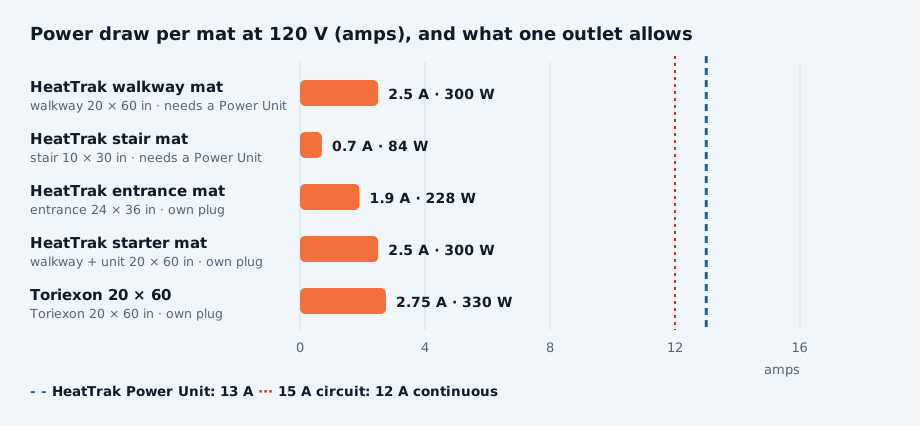
HeatTrak publishes amps for each mat, while the Toriexon listing gives watts. At 120 V, watts equal volts times amps, so one converts to the other, and the table shows both with our arithmetic marked.
| Mat | Amps | Watts | Runs from |
|---|---|---|---|
| HeatTrak walkway 20 × 60 in | 2.5 A | about 300 W (our arithmetic) | HeatTrak Power Unit |
| HeatTrak stair 10 × 30 in | 0.7 A | about 84 W (our arithmetic) | HeatTrak Power Unit |
| HeatTrak walkway 30 × 60 in | 3.5 A (dealer listing) | about 420 W (our arithmetic) | HeatTrak Power Unit |
| HeatTrak entrance 24 × 36 in | 1.9 A | about 228 W (our arithmetic) | Its own GFCI unit |
| Toriexon 20 × 60 in | about 2.75 A (our arithmetic) | 330 W | Outdoor GFCI outlet |
Adding up a chain, the manual’s example
HeatTrak’s HR20-60 manual works through a typical set. Three 20 × 60 in walkway mats at 2.5 A each come to 7.5 A, and five 10 × 30 in stair mats at 0.7 A each add another 3.5 A.
- Walkway mats: 3 × 2.5 A = 7.5 A
- Stair mats: 5 × 0.7 A = 3.5 A
- Total on one Power Unit: 7.5 A + 3.5 A = 11 A
Eleven amps fits under the Power Unit budget with a little to spare. Your own list works the same way, one line per mat type, and our mat size guide helps you get the counts right first.
The Power Unit budget, 13 A or 14 A
HeatTrak’s FAQ and the walkway listings say no more than 13 A on a single plug. The stair and entrance listings say up to 14 A, and the manual says the unit can safely handle 15 A while recommending you stay at or below 14 A.
Plan on 13 A, the lowest of the three figures and the one in HeatTrak’s own FAQ. By our arithmetic that allows five walkway mats (12.5 A) or eighteen stair treads (12.6 A), or any mix that totals less.
Past 13 A, split the chain. Buy a second Power Unit and run it from a second outlet, ideally on another circuit, because two units on one circuit still share that circuit’s limit.
The circuit and the 80% rule
Most US household circuits are 15 A or 20 A. A heated mat is a continuous load, running for hours at a stretch, and the National Electrical Code rule of thumb keeps continuous loads at or below 80% of the breaker rating.
On a 15 A circuit that means 12 A. A full 13 A chain can be too much for a 15 A circuit even with nothing else on it, while a 20 A circuit allows 16 A and leaves the Power Unit as the tighter limit.
If you don’t know whether the outdoor outlet sits on a 15 A or a 20 A circuit, or what else shares it, ask an electrician before you plug in a long chain.
Other loads on the same circuit
A breaker counts every load on its circuit, mats included. A garage freezer or a string of porch lights on the same line eats into the 12 A or 16 A you have to work with.
Take the manual’s 11 A set on a 15 A circuit. It already sits close to the 12 A guideline, so a freezer that kicks on overnight could be the load that trips the breaker while snow is still coming down.
If the circuit is shared, trim the chain or move part of it to another outlet. A shorter chain on a quiet circuit beats a long one that drops out halfway through a storm.
Toriexon and standalone mats
Mats with their own plug skip the Power Unit but not the circuit. The HeatTrak entrance mat draws 1.9 A through its own GFCI unit, and the Toriexon plugs straight into an outdoor GFCI outlet at about 2.75 A by our arithmetic.
Toriexon says its mats can be connected as long as the total stays under 1,500 W, which works out to 12.5 A at 120 V. Four of its 330 W mats make 1,320 W, about 11 A, and a fifth would go over.
Extension cords and HeatTrak extenders
The Power Unit comes with a 6 ft cord. If the outlet is farther away, HeatTrak’s FAQ allows an outdoor-rated extension cord of 14 gauge or heavier, as long as the connection stays out of water.
A lower gauge number means a thicker wire, so a 12 gauge cord is heavier than 14 and fine, while 16 gauge is too light. Indoor cords don’t belong outside at all.
HeatTrak also sells watertight extenders in 10 ft and 25 ft lengths with its own connectors, and they can be chained. Routing them safely is covered in our guide to cords, GFCI and safety.
Whatever the amps add up to, the outlet itself must be GFCI protected and fitted with an in-use cover. A correct sum on an unprotected outlet is still an unsafe setup.
Putting it together
For a first HeatTrak chain, the walkway mat with Power Unit gives you the unit and one mat in a single box, with 10.5 A of the budget left. Steps are the usual next addition, and our guide to heated mats for steps covers them.
Amps also drive the power bill, since every amp at 120 V is about 120 W. Our running cost guide turns that into kWh, and the comparison table lists each mat’s draw side by side.
The homepage card for the ready-to-plug-in starter mat sums up the unit-included option. If you are still deciding which snow melting mat to buy for your outlet, the full list of picks starts there.
For a first chain of mats
The HeatTrak walkway mat with Power Unit puts the GFCI unit and a 2.5 A mat in one box, leaving 10.5 A of the 13 A budget for more mats. Check what else shares the circuit before you fill that space.
