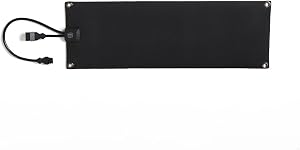
HeatTrak walkway mat, the snow melting mat we would buy first
The HeatTrak HR20-60 has more owner reviews than any other snow melting mat on Amazon, and it is the one we would point a friend to first. It has one catch that surprises plenty of buyers, because the mat ships without the Power Unit it needs. We did not lay one out ourselves, so this review weighs HeatTrak’s listing, FAQ and manual against what owners report.
 Our top pick
Our verdict
The HR20-60 is the safest choice in this lineup, from a maker that publishes its amps, its melt rate and a 2-year warranty, with plenty of owner reviews behind it. It covers a stoop or the busiest stretch of a path and grows into a full chain with stair treads later. On its own it does nothing, though, because the GFCI Power Unit is sold separately and owners complain about that more than anything else. If you have no unit yet, the version with the unit included is the simpler buy.
Strengths
- The most-reviewed snow melting mat on Amazon
- Up to 2 in of snow an hour, per HeatTrak
- Draws only 2.5 A, so one unit can run a long chain
- Made to stay outside all winter
- 2-year warranty from the date of shipment
Weaknesses
- Does nothing until you add a Power Unit, sold separately
- Some owners report failures after about five years
- Owners split on whether the price is fair
- The unit’s cord is 6 ft, so a distant outlet means an extender
- Can fall behind in very heavy snowfall
Buy it if
you want a proven mat for a stoop or path and either own a HeatTrak Power Unit already or plan to grow a chain of mats around one.
Skip it if
you have no Power Unit and want a single box that works on the day it arrives, or you have no GFCI-protected outdoor outlet nearby.
Specs: HeatTrak Walkway Mat 20 × 60 in
| Type | Heated walkway mat, chains to other HeatTrak mats |
|---|---|
| Model | HR20-60 |
| Size | 20 × 60 in, about 0.5 in thick |
| Power draw | 2.5 A at 120 V (about 300 W, our arithmetic) |
| Melt rate | Up to 2 in of snow per hour (HeatTrak) |
| Surface temperature | About 40 °F above the air temperature; works down to -8 °F (listing) |
| Power | HeatTrak Power Unit required, sold separately (GFCI, 6 ft cord, up to 13 A of mats per HeatTrak’s FAQ) |
| Other sizes | 20 × 30, 30 × 30 and 30 × 60 in on the same listing |
| Surface | Non-slip rubber on both sides of the heating element |
| Weight | 8.28 lb (listing) |
| Season use | Made to stay outside all winter |
| Warranty | 2 years from shipment |
Data from the manufacturer’s manual and spec sheet and from the Amazon listing. Price band $$: $150 to $250. Only the price Amazon shows at checkout counts.
A 20 × 60 in mat for a stoop or path
The HR20-60 measures 20 × 60 in, a strip about one walker wide and 5 ft long. That covers the landing at a front door or the busiest stretch of a path, but not a whole walk from the driveway.
The same listing offers 20 × 30, 30 × 30 and 30 × 60 in versions, and a dealer listing puts the larger 30 × 60 in mat at 3.5 A. The narrow 20 in mat suits a path, while the 30 in widths make more sense on a landing where two people stand.
Measure before you buy and count in feet rather than hopes. A 20 ft path takes four of these mats end to end, and our guide to how many mats you need works through stoops, paths and steps.
The mat is about 0.5 in thick and weighs 8.28 lb, so it is a solid slab rather than a thin sheet. Lay it where nobody kicks the edge, since a lifted corner is a trip hazard on any path.
No power at all until you add the unit
This is the point owners raise more than any other. The HR20-60 ends in a HeatTrak connector instead of a household plug, and it stays cold until you add the HeatTrak Power Unit, sold separately.
The Power Unit is a box rated for outdoor use that holds a GFCI and ends in a 6 ft cord. It plugs into a 120 V outlet, this mat plugs into the unit, and more mats or stair treads daisy-chain from there.
If this is your first HeatTrak, the Power Unit bundle gives you this same mat with the unit packed alongside. Buy the plain HR20-60 to extend a chain you already own, or when you plan to order the unit separately.
At 120 V each mat pulls 2.5 A, or roughly 300 W by our arithmetic. One unit takes up to 13 A of mats per HeatTrak’s FAQ (some listings say 14), so five of these mats come to 12.5 A on a single unit.
The circuit matters as much as the unit. A continuous load should stay at or below 12 A on a 15 A circuit, and a garage freezer or porch lights on the same breaker count too. If you are unsure what your outlet feeds, ask an electrician.
Up to 2 in an hour, 40 °F above the air
By HeatTrak’s rating, the mat clears up to 2 in of snow an hour while its surface sits about 40 °F warmer than the air. The walkway listing adds that it works well down to -8 °F.
Read those as the maker’s figures, not a promise for every storm. Wind strips heat off the surface, and in very heavy snowfall or deep cold any mat can lose ground, so turn it on ahead of the first flakes.
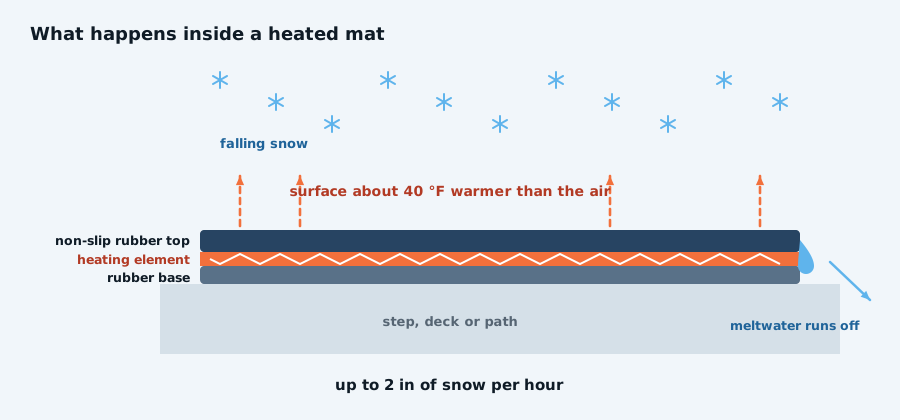
No thermostat is listed, so the mat heats whenever it has power. HeatTrak’s FAQ says leaving it on through the winter does not wear it out, and our explainer on how heated mats melt snow covers the physics behind the 40 °F margin.
Running cost follows from the watts. Ten hours at about 300 W adds up to 3 kWh, which you can price with the rate printed on your utility bill. For a typical set, HeatTrak’s own estimate is about 18 cents an hour.
Laying it out and plugging it in
Lay the mat flat where you walk, with the connector end toward the outlet. The outlet must be an outdoor one with GFCI protection and an in-use cover, as the US electrical code expects for outdoor receptacles.
If the outlet sits more than 6 ft away, HeatTrak offers 10 ft and 25 ft watertight extenders that use the same connectors. A regular extension cord is also fine when it is made for outdoor use, 14 gauge or heavier, with the plug joint held clear of water.
Route cords along the side of the path, never across the line people walk, and never close a door on one. Never cut a mat to fit a gap either; order a different size instead.
Wood decks are fine, per HeatTrak. Composite decking calls for a layer beneath the mat made of something other than vinyl or rubber, and HeatTrak lists thin 1/8 in plywood or a polypropylene outdoor rug as choices.
Five to six years with sensible care
HeatTrak gives an average life of 5–6 years with proper care and a 2-year warranty from the date of shipment. The warranty covers defects, while abuse and a faulty installation fall outside it.
Most damage comes from tools. Keep shovels, ice chippers, metal scrapers and snow blowers off the mat, and let the heat do the clearing instead.
At the end of winter, let the mat cool, then store it flat if you can, or rolled, somewhere dry and cool. Check the cords and plugs and cap the connectors or wrap them in electrical tape. Our care and storage guide goes through it step by step.
What owners say after a few winters
With plenty of owner reviews, the patterns are clear. Owners say it keeps porches and steps clear and warms up quickly, and many describe it as durable over several winters.
The complaints are about money and the missing piece. Opinions on value are mixed because it is not cheap, and the most common gripe is that the Power Unit and its cord are not in the box.
A few owners report a mat failing after about five years. That lines up with HeatTrak’s own 5–6 year average, so treat it as the expected lifespan rather than a defect.
Against the starter kit and the Toriexon
The starter version, the HR20-60P, is this exact mat with the unit attached, and it sits in the $$$ band against this one’s $$. If you own no unit yet, it saves you a second order and the most common owner complaint.
The Toriexon 20 × 60 mat is the same size at 330 W and plugs straight into an outdoor GFCI outlet with no unit. It has few owner reviews so far and no stated warranty term, and our HeatTrak vs Toriexon comparison weighs the two side by side.
For steps, add HeatTrak stair treads onto the same unit, each drawing 0.7 A. This mat heads our top pick card, and all five sit together in our roundup of the best snow melting mats.
The mat we would start with
A maker that publishes its figures, a modest 2.5 A draw and plenty of owners behind it make the HR20-60 the easiest mat here to recommend. Pair it with a Power Unit on a covered GFCI outlet, keep the shovel off it, and your path stays clear for winters to come.