The HeatTrak walkway mat against the Toriexon snow mat
Both mats measure 20 × 60 in, run on 120 V and promise up to 2 in of snow per hour. The differences lie in how they get their power and how much you can know about each one before you buy.
HeatTrak for a chain of mats, Toriexon for one mat on one outlet
If you plan to heat a path and a few steps, the HeatTrak walkway mat is the stronger choice. It chains to stair treads and other walkway mats from one Power Unit, carries a 2-year warranty and is the most-reviewed snow melting mat on Amazon.
If you want one mat on one outlet with no extra box, the Toriexon is simpler to start with. It plugs straight into an outdoor GFCI outlet and sits in the same $$ band as the plain HeatTrak mat.
Both rank among our top heated snow mats, as pick 1 and pick 5 on the homepage. Which one suits you depends on your steps, your path and your outlet more than on the badge.
The two mats, spec by spec
Figures come from the Amazon listings and HeatTrak’s residential FAQ. Where a source gives no figure, the table says so.
| Feature | HeatTrak walkway mat (HR20-60) | Toriexon 20 × 60 mat |
|---|---|---|
| Size | 20 × 60 in, about 0.5 in thick | 20 × 60 in |
| Coverage | About 8.3 sq ft (our arithmetic) | About 8.3 sq ft (our arithmetic) |
| Power draw | 2.5 A, about 300 W at 120 V (our arithmetic) | 330 W, about 2.75 A at 120 V (our arithmetic) |
| Power unit needed | Yes, HeatTrak Power Unit, sold separately | No, own plug |
| GFCI | In the Power Unit, trips above 6 mA | From your outdoor outlet; none claimed in the mat |
| Chaining | Up to 13 A per Power Unit per HeatTrak’s FAQ (some listings say 14) | Up to 1,500 W in total (listing) |
| Melt rate | Up to 2 in per hour | Up to 2 in per hour (listing) |
| Cold rating | About 40 °F above the air; works down to -8 °F (listing) | Not stated |
| Fixing | Not stated on the listing | Not stated on the listing |
| Owner feedback | Plenty of reviews; effective and durable, missing Power Unit is the top complaint | Few owner reviews so far |
| Warranty | 2 years from shipment | Not stated on the listing |
| Price band | $$, plus the Power Unit | $$ |
A Power Unit against a plug of its own
The HeatTrak mat draws 2.5 A, about 300 W at 120 V by our arithmetic, through a separate Power Unit. The Toriexon draws 330 W, which works out to about 2.75 A, straight from the wall.
That 30 W gap won’t show on a single mat. What matters more is where the GFCI sits, because HeatTrak builds it into the Power Unit while Toriexon needs an outdoor outlet that already has GFCI protection.
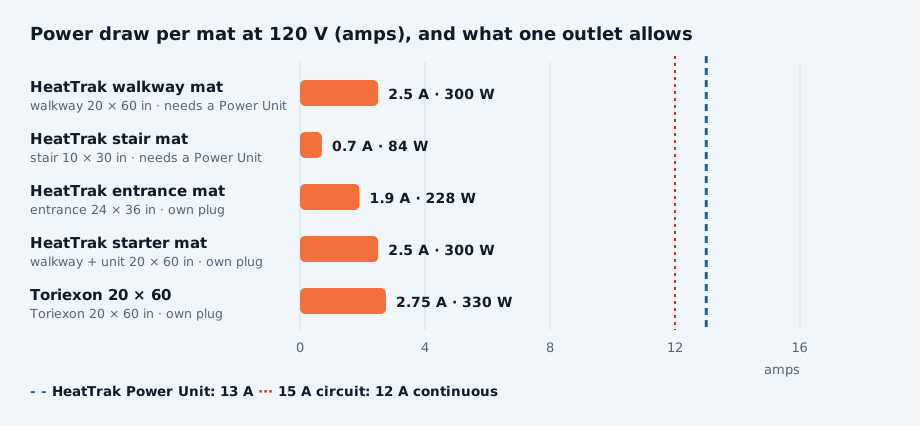
Either way, the outlet needs an in-use cover and the circuit needs room for the load. Our guide to amps, outlets and breakers shows how to add up what else runs on the same circuit.
Round goes to HeatTrak, for a GFCI you know is there.
Adding a second mat or a row of steps
HeatTrak was built for chains. One Power Unit runs up to 13 A of walkway and stair mats per HeatTrak’s FAQ (some listings say 14), and the manual’s example of three walkway mats and five stair treads comes to 11 A.
Toriexon says its mats can be connected up to 1,500 W in total. By our arithmetic that allows four 330 W mats at 1,320 W, or about 11 A, which also stays under the 12 A continuous limit for a 15 A circuit.
HeatTrak offers 10 × 30 in treads and 10 ft or 25 ft extenders that join with its watertight connectors. Toriexon sells 10 × 30 in packs too, but its listing gives no detail on how the pieces connect.
Round goes to HeatTrak, for a chaining system with clear limits and extenders.
Melting and the cold
Both listings promise up to 2 in of snow per hour. The Toriexon has 30 W more to work with, but the gap is small, and wind or a heavy snowfall will matter more than the badge on the mat.
HeatTrak states that its surface runs about 40 °F above the air temperature and that the walkway mat works well down to -8 °F. Toriexon gives no cold rating, so you can’t compare the two in a hard freeze.
Either mat can fall behind in a very heavy storm. Turn it on ahead of the first flakes, not once the path is already buried.
Round goes to HeatTrak, narrowly, for a stated cold rating.
Surface and life outdoors
HeatTrak sandwiches its heating elements between two non-slip rubber surfaces and says they are built to stay outside for the whole winter. Its listing gives the walkway mat a thickness of about 0.5 in and a weight of 8.28 lb.
Toriexon describes its surface as waterproof, anti-slip and wear-resistant. Neither listing gives a formal waterproof rating, so keep both mats’ connections out of standing water.
This round is a draw.
Track record and warranty
No snow melting mat on Amazon has more owner reviews than the HeatTrak walkway mat. Owners say it heats up quickly and holds up on porches and steps, while some report failures after about five years.
HeatTrak gives 2 years from shipment and puts the average life at 5–6 years with proper care. Toriexon has few owner reviews so far and states no warranty, and we found no maker manual.
Our HeatTrak walkway mat review and Toriexon mat review go through both in more depth. The second is shorter for one reason, there is less on record about the mat.
Round goes to HeatTrak.
What you pay for a working first mat
Here the Toriexon pulls ahead. It sits in the $$ band and works out of the box, while the plain HeatTrak mat also sits in $$ but does nothing until you add a Power Unit.
HeatTrak sells the same mat with the unit included as the HR20-60P, which lands just over the $250 line. If you already own a Power Unit, the plain mat is the cheaper way to extend your chain.
Round goes to Toriexon, for a lower cost on a first mat.
Which one should you buy?
Choose the HeatTrak if you want to heat steps and a path from one outlet over several winters, or if you already own a Power Unit. Choose the Toriexon if you need one mat by a door and your outdoor outlet already has GFCI protection.
Our look at snow melting mat brands covers the companies behind both mats. It also lists what to check on the unbranded mats you will see beside them on Amazon.
This comparison leans on uneven evidence. HeatTrak backs its mat with an FAQ, a manual and plenty of owner reviews, while the Toriexon has a listing and few reviews so far, so its long-term durability is unknown.
Either mat belongs on an outdoor outlet that has GFCI protection and an in-use cover. Use only outdoor-rated 14-gauge or heavier extension cords. Never cut either mat, and keep shovels and snow blowers off them.
Which of the two we would buy
For most homes we would buy the HeatTrak walkway mat and plan for a Power Unit, because it grows into a full chain and comes with a 2-year warranty. If you want one mat working from a single outlet, the Toriexon is the simpler start.

