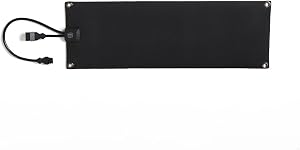
How many snow melting mats you need
Most heated mat regrets come down to size, either a strip that leaves half the path icy or a chain that asks more of one outlet than it can give. Four steps with a tape measure sort it out before you order.
The four steps at a glance
Sizing a heated mat setup is mostly tape measure work. Go through these in order and you finish with a shopping list that fits your path, your stairs and the outlet that has to feed them.
- Measure the walking line: the strip where feet land, not the full width of the path
- Count the steps: one tread per step, matched to the width of that step
- Add up the amps: every mat on one Power Unit shares a single budget
- Plan the cord run: from the outlet to the first mat, plus any gaps
Step 1, measure the walking line
You don’t need to heat a whole path. Measure the strip people walk on, usually down the middle, and note its length in feet, because mats come in fixed sizes and you cover the run with whole mats.
The usual HeatTrak walkway mat is 20 × 60 in, so each one covers 5 ft of length on a strip 20 in wide. A 15 ft front walk takes three of them laid end to end, and a 30 × 60 in size exists if 20 in feels narrow.
Other HeatTrak walkway sizes on the listings are 20 × 30, 30 × 30 and 30 × 60 in. The Toriexon also comes as 20 × 60 in, with 30 × 48, 36 × 60 and 36 × 72 in versions in the same family on Amazon.
Step 2, count the steps
Stairs take treads, not walkway mats. HeatTrak’s 10 × 30 in stair mat covers one step, so five steps mean five treads, and the same listing offers 10 × 48 and 10 × 60 in for wider stairs.
Measure the width of each step and choose the tread that fits without hanging past the edge. An overhanging tread is a trip hazard, and a heated mat must never be cut down to fit.
Toriexon sells 10 × 30 in pieces in packs of one, three, four or five. Our guide to heated mats for steps goes deeper into stair setups of every shape.
The door landing is its own case
For one landing at a door, a single standalone mat can beat a chain. The HeatTrak entrance mat measures 24 × 36 in, draws 1.9 A and brings its own GFCI power unit, so it plugs straight into an outdoor outlet.
The trade-off is that it cannot connect to any other mat. Larger entrance sizes exist (30 × 48 in and 2 ft 6 in × 4 ft), but steps below the door still need their own treads on a Power Unit.
Step 3, add up the amps
Every HeatTrak walkway and stair mat runs from a Power Unit, and each unit has a budget. HeatTrak’s FAQ caps it at 13 A on a single plug, while the listings for the stair and entrance mats allow up to 14 A.
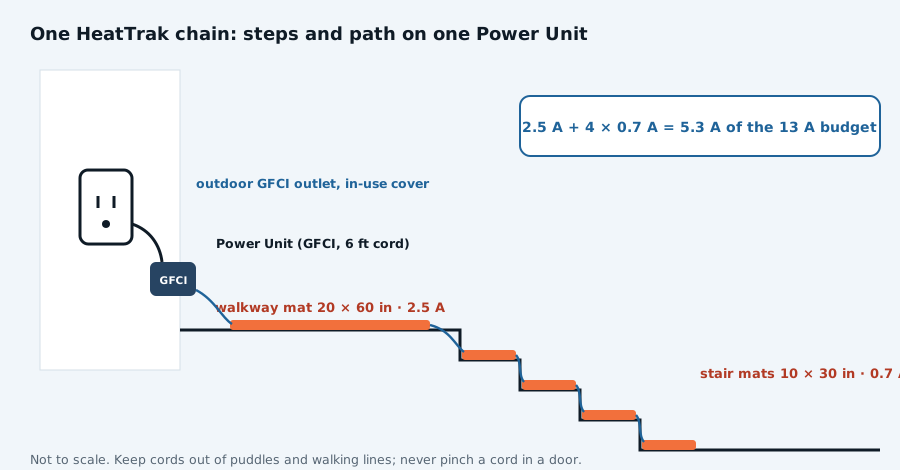
A 20 × 60 in walkway mat draws 2.5 A and a 10 × 30 in tread draws 0.7 A. One walkway mat plus four treads comes to 5.3 A, comfortably under the cap, and the figure below shows that chain from outlet to top step.
HeatTrak’s manual shows a bigger set, three walkway mats and five stair mats for 11 A. That still fits one unit, but the circuit behind the outlet has its own limit, which our guide to amps, outlets and breakers explains.
Step 4, plan the cord run
The Power Unit has a 6 ft cord, and so does the entrance mat’s unit. Measure from the outdoor outlet to where the first mat begins, and if that distance is longer, plan on an extension.
HeatTrak sells watertight 10 ft and 25 ft extenders with its own connectors, and the listing pitches them for a mat sitting more than 6 ft from an outlet. They can be chained together for a longer run.
An ordinary extension cord does the job too, provided it is rated for outdoor use and is 14 gauge or thicker, with the joint kept dry. Route it along the edge of the path and never under a door, where it gets pinched.
Sample layouts and their amps
These four setups cover most front doors. The amps come from the listings and HeatTrak’s manual, and every HeatTrak chain stays well inside one Power Unit.
| Layout | Mats | Total draw | Power |
|---|---|---|---|
| Door landing only | 1 HeatTrak entrance mat, 24 × 36 in | 1.9 A | Its own GFCI unit |
| Short walk and four steps | 1 walkway mat + 4 stair treads | 5.3 A | 1 Power Unit |
| 15 ft walk and five steps | 3 walkway mats + 5 stair treads | 11 A | 1 Power Unit |
| One strip, no unit | 1 Toriexon mat (20 × 60 in) | roughly 2.75 A by our arithmetic | Outdoor GFCI outlet |
For a first HeatTrak chain, the walkway mat with the Power Unit included is the starting piece, and further walkway mats or treads plug in behind it. If you already own a unit, the plain mat or the treads are all you add.
Surface and coverage checks
Before ordering, check what the mats will rest on. HeatTrak’s FAQ calls wood decks compatible, while composite boards need a non-staining barrier under the mat, and our guide to wood, composite and concrete lists the options.
It also helps to see why coverage beats wattage, which our explainer on how heated mats melt snow covers. Then compare sizes and draw in the homepage comparison table, or go straight to the stair mat pick.
If you would rather see all the snow melting mats compared before measuring anything, the homepage lists the five with their sizes, power needs and the catch of each one.
For steps leading up to the door
Five steps take five HeatTrak stair treads at 0.7 A each, 3.5 A in all, which leaves room on one Power Unit for a walkway mat or three. Order the Power Unit too if you don’t own one yet, because the treads do nothing without it.