HeatTrak stair mat, one heated tread per step
The HeatTrak HR10-30 is a heated tread made to sit on one outdoor step, and the only mat of our five in the $ band. Like the walkway mat, it does nothing without a HeatTrak Power Unit bought separately. This review draws on HeatTrak’s listing and FAQ and on owner reports, since we did not fit a set ourselves.
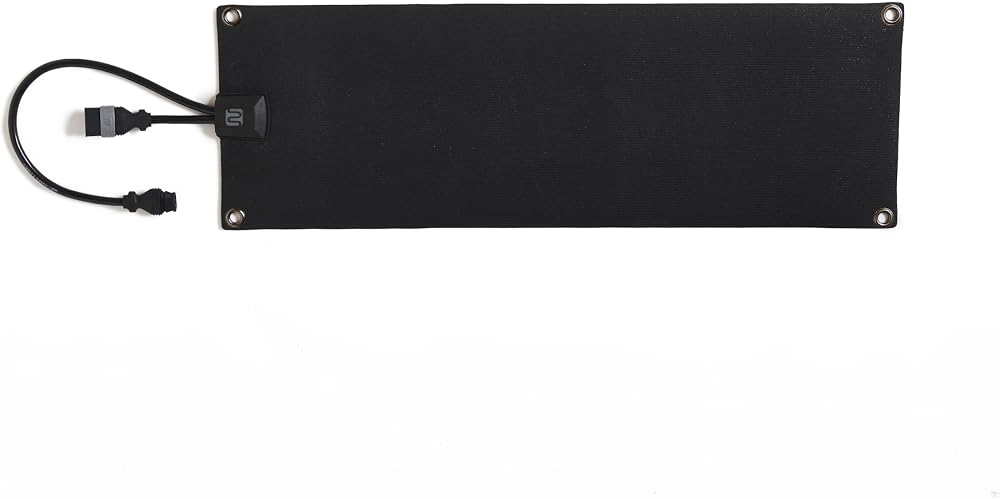 Best for steps
Our verdict
The HR10-30 is the cleanest way to keep outdoor steps clear, one tread per step, all fed from a single HeatTrak Power Unit. At 0.7 A a tread, even a long flight barely dents the 13 A budget. The low band is misleading, though, because you need a tread for every step plus a Power Unit sold separately. Owners agree it keeps steps clear, while they split on how warm the surface gets.
Strengths
- Only 0.7 A per tread, so one unit runs a long flight
- Owners say it keeps steps clear and feels safe underfoot
- Chains with HeatTrak walkway mats on one unit
- The only mat of the five in the $ band
- Made to stay out all winter, with a 2-year warranty
Weaknesses
- Needs a Power Unit, sold separately
- One tread per step, so a flight multiplies the cost
- Owners split on how warm the surface gets
- Price opinions among owners are mixed
- Covers 10 in of depth, so a deep step stays partly bare
Buy it if
you have a flight of outdoor steps and want each one heated, ideally from the same Power Unit as a walkway mat.
Skip it if
you need a single plug-in mat that works straight from the box, or you only have one landing to clear and no steps at all.
Specs: HeatTrak Stair Mat 10 × 30 in
| Type | Heated stair tread, chains to other HeatTrak mats |
|---|---|
| Model | HR10-30 |
| Size | 10 × 30 in, about 0.5 in thick |
| Power draw | 0.7 A per tread at 120 V (about 84 W, our arithmetic) |
| Melt rate | Up to 2 in of snow per hour (HeatTrak) |
| Power | HeatTrak Power Unit required, sold separately (one unit runs up to 13 A of mats per HeatTrak’s FAQ; the listing says 14) |
| Other sizes | 10 × 48 and 10 × 60 in on the same listing |
| Weight | 2.89 lb (listing) |
| Season use | Made to stay outside all winter |
| Warranty | 2 years from shipment |
Data from the manufacturer’s manual and spec sheet and from the Amazon listing. Price band $: under $150. Only the price Amazon shows at checkout counts.
Sizing one tread for each step
The HR10-30 measures 10 × 30 in and about 0.5 in thick, sized to sit on a single step. HeatTrak sells the same tread at 10 × 48 and 10 × 60 in for wider stairs, all on one listing.
Measure every step before you order. The width decides which of the three lengths you pick, and you need one tread per step, so a flight of five takes five treads.
The 10 in depth covers the part of a step where your foot lands, but a deep step will show bare concrete at the back. A landing takes a walkway mat instead, and our guide to heated mats for steps covers the awkward shapes.
Each tread weighs 2.89 lb, light enough to lift off and stack in spring. The details we rely on describe no fixing kit for the treads, so lay them square and check them after a windy night.
The Power Unit and the 0.7 A budget
This is the catch owners keep finding out on the doorstep. The tread has a HeatTrak connector, not a household plug, so it needs the HeatTrak Power Unit, sold separately, or a walkway mat already plugged into one.
Each tread draws 0.7 A at 120 V, which works out to about 84 W. HeatTrak’s FAQ caps one unit at 13 A of mats (this listing says up to 14), so the arithmetic allows 18 treads before you need a second unit.
Mixing sizes is where the system earns its keep. One walkway mat and four treads come to 5.3 A, and HeatTrak’s manual describes three walkway mats with five treads at 11 A on one unit.
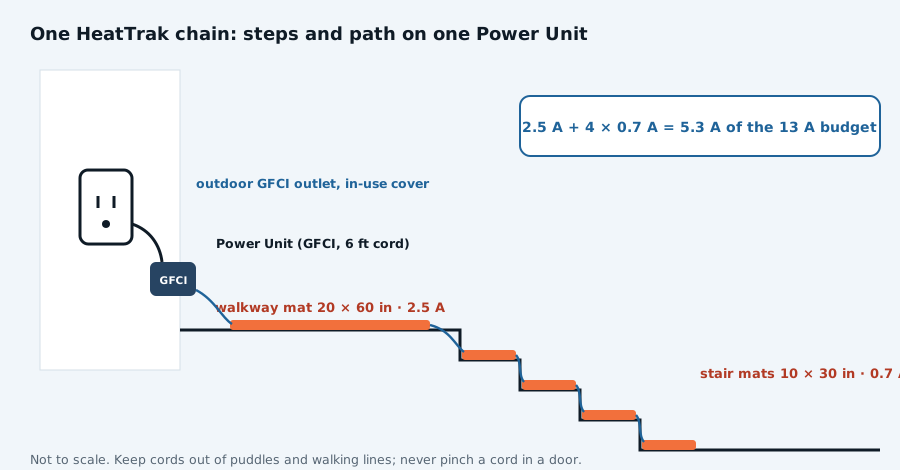
The breaker still has the final say. On a 15 A circuit, aim to keep anything that runs for hours under 12 A in total, counting every other device on it. Our guide to breakers and outlets shows the sums, and an electrician can tell you what else your porch outlet feeds.
Heat on the steps in a storm
Every HeatTrak mat carries a rating of up to 2 in of snowfall per hour, and the surface holds at roughly 40 °F over the air temperature. The tread carries the same rating as the walkway mats, spread over a smaller footprint.
Owners split on the warmth. Some report a very warm surface within 15 minutes, while others find it not warm enough, which fits a mat that adds a fixed margin over whatever the air is doing.
Start the treads before the snow arrives and leave them running through the storm, since HeatTrak’s FAQ says that does not wear them out. In wind or deep cold they can fall behind, and rock salt is little help below about 15 °F.
Running cost per tread is small. Four treads at 84 W for 10 hours use about 3.4 kWh, so your power bill’s rate per kWh does the rest.
Fitting and cabling a flight
Start at the step nearest the outlet and run the chain step by step, with the connectors at the side of the stairs. Keep every joint out of puddles, and never let a cord cross the middle of a step where feet land.
Where the outlet is far off, HeatTrak’s watertight 10 ft and 25 ft extenders use the same connectors. A standard extension cord has to be built for outdoor use and 14 gauge or heavier, and its connection should stay dry.
Wood steps are fine, per HeatTrak. Composite steps need something non-staining underneath, with vinyl and rubber ruled out for that layer, and our guide to wood, composite and concrete covers that in detail.
Never trim a tread to fit a narrow step, because a cut mat is a ruined mat. Pick the 30 in length and leave a little bare step at each side instead.
Durability and season-end storage
HeatTrak backs the treads with a 2-year warranty from shipment and quotes 5–6 years of life on average with proper care. Owners say the treads hold up, which matches that picture.
Shovels and ice chippers are the fastest way to ruin a tread. Keep metal tools and snow blowers off the steps entirely while the treads are down.
HeatTrak designs the treads to stay out all season, so there is no need to lift them between storms. Leaving them in place also spares the connectors from being pulled apart and pushed together every week.
In spring, let the treads cool, then stack them flat in a dry, cool place. Inspect the cords and plugs, and cap or tape the connectors before they go on the shelf.
How owners rate the treads
Owners mostly say the treads keep their steps clear and make concrete steps feel safe in icy weather. Many also call them easy to set up and say they last.
The split is on price and warmth. Some think the cost runs high once a whole flight is covered, and reports on surface heat range from very warm to not warm enough.
Treads against a walkway mat or Toriexon
For a stoop with a landing, pair these with the HeatTrak walkway mat on the same unit. If you own no unit yet, start with the walkway mat that includes the Power Unit and chain the treads to it.
The Toriexon 20 × 60 mat plugs straight into an outdoor GFCI outlet, but it is one long mat rather than a tread system. Toriexon sells 10 × 30 in packs too, with few owner reviews so far.
The HeatTrak entrance mat cannot join a chain, so it makes no partner for these treads. If the door at the top of your steps needs heat as well, a walkway mat on the same unit covers it.
On a tight budget, our look at snow melting mats under $150 explains why the tread’s $ band hides a bigger bill. The stair mat card on our homepage and our snow melting mat comparison show it next to the other four.
For steps that ice over first
One tread per step, all running from one Power Unit at a fraction of its budget, is the neatest fix for outdoor stairs. Order the unit with them, plug it into a covered GFCI outlet, and your steps stop being the riskiest part of the walk.


