When snow falls faster than a heated mat can melt it
Heated mats handle most winter storms, and the ones they don’t handle tend to share a pattern. Heavy snowfall, bitter cold and wind each eat into a fixed amount of heat, and knowing the limits tells you when to help the mat out.
The two numbers that set the limit
Every HeatTrak mat comes with two performance figures. It melts up to 2 in of snow per hour, and its surface runs about 40 °F above the ambient air temperature, according to the listings and HeatTrak’s FAQ.
Both figures describe a fixed amount of heat. A mat turns all of its electrical power into heat, and its watts decide how fast it melts, along with wind, air temperature and how much snow falls.
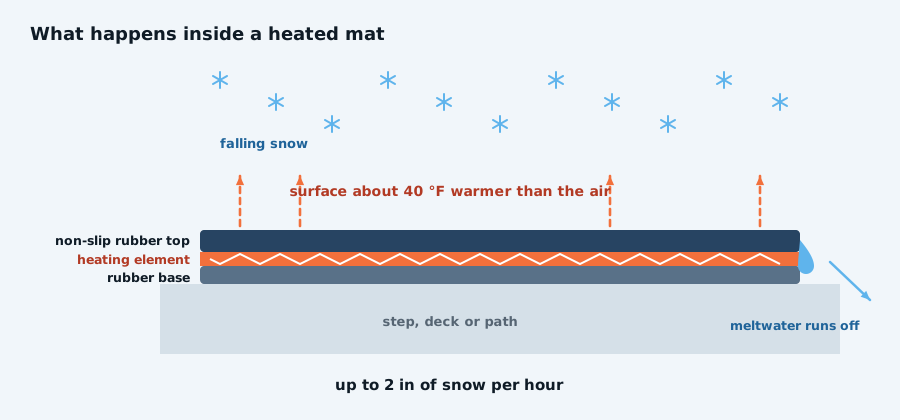
The figure shows the layers, snow on a rubber top, the heating element in the middle and the base on the ground. Heat flows up into the snow and down into the ground, and only the share that reaches the snow does the melting.
The background is in how heated mats melt snow. This page is about the storms that push a mat past those two numbers.
What the 40 °F rise means in practice
The 40 °F figure is a rise over the ambient temperature, not a fixed surface heat. As the air gets colder the mat’s surface gets colder with it, by HeatTrak’s own description.
| Air temperature | Surface if the 40 °F rise holds | Margin above freezing (32 °F) |
|---|---|---|
| 30 °F | About 70 °F | Wide |
| 10 °F | About 50 °F | Comfortable |
| 0 °F | About 40 °F | Narrow |
| -8 °F | About 32 °F | None left |
The table is our arithmetic on HeatTrak’s figure, and the figure itself is an approximation. It still shows the trend clearly, since every degree of cold takes a degree off the surface.
The -8 °F listing claim
According to the HeatTrak walkway listings, the mats keep working well as low as -8 °F. That matches the arithmetic above neatly, because -8 °F plus 40 °F lands right on the freezing point.
Read it as the edge of the range, not a comfortable working temperature. At -8 °F a mat has no heat to spare, so any snowfall, wind or cold start pushes it behind.
Stair treads and the entrance mat share the 40 °F figure, but the -8 °F claim appears on the walkway listings in our sources. The Toriexon listing gives a melt rate of up to 2 in per hour and no cold rating.
Snow faster than 2 in per hour
A heavy storm can drop snow faster than 2 in per hour for a while. When that happens, the snow simply arrives faster than the mat can melt it, and a layer builds up on top.
The rate is also a best case. Air temperature is one of the things that decides how fast a mat melts, so expect less than the headline figure when a storm arrives with bitter cold.
A layer of snow on the mat is not a fault. Once the snowfall slows below the mat’s pace, it works down through the pile from underneath.
Wind and a cold start
Wind carries heat off the mat’s surface and blows drifts onto it. A mat on an exposed porch corner or a windy stair can fall behind in a storm that a sheltered mat handles easily.
A cold start costs time too. A mat switched on after a few inches have fallen first has to warm itself, then the frozen snow pressed onto it, before it gains on the storm.
That is why the advice is to switch on before the snow starts. HeatTrak’s FAQ says leaving mats on all winter does not wear them out, so turning them on early carries no penalty beyond the power used.
Why mats fall behind
- Snowfall heavier than about 2 in per hour
- Air near or below -8 °F, where the 40 °F rise runs out
- Wind stripping heat and piling drifts
- A cold start under snow that has already fallen
- A tripped GFCI or a loose connector, so part of the chain is cold
- Snow shoveled or plowed onto the mat from elsewhere
The last two are the ones you can fix. Check the Power Unit and connections when one mat stays white while the others clear, and keep snow from the rest of the yard off the mats.
Helping a mat catch up
When a mat falls behind, leave it on and let it work. Push loose snow off the sides with a boot, but never use a shovel, metal tool, ice chipper or snow blower on the mat itself.
Long runs use more power, but the arithmetic is easy to check. A 300 W walkway mat on for 24 hours uses 7.2 kWh, and the guide to running costs shows how to price that at your own rate.
After a hard winter, look each mat over before storing it. The care and storage guide covers the spring routine and the 2-year warranty.
Keep the mats running until the storm has passed and their surface is clear and wet rather than white. Switching off too early leaves meltwater on the mat to freeze into a glaze overnight.
No heated mat is a guarantee in a blizzard. In very heavy snowfall or deep cold, plan to help it along, and if your winters regularly bring both, compare mats with salt and heat cable before you buy.
Picking a mat for hard winters
For a first set, the HeatTrak walkway mat with its Power Unit carries the -8 °F claim and starts a chain you can extend with treads. Our review of the mat with Power Unit covers its setup.
If the steps take the worst of the wind, add stair treads to the same chain. At 0.7 A each they use little of the 13 A that HeatTrak’s FAQ allows per Power Unit.
See all five heated snow mats compared on the home page, and read how the mats work for the short version. The starter mat card lists its size and band.
If your winters bring deep cold
The HeatTrak walkway mat with Power Unit is rated down to -8 °F on its listing and melts up to 2 in per hour by HeatTrak’s figure. Switch it on before the storm and it has the best chance of keeping up.