How heated mats melt snow from underneath
A heated mat looks like a plain rubber runner, yet it turns outlet power into warmth right under your boots. Once you see how that heat moves, the melt-rate claims and the limits on bitter nights start to make sense.
What sits inside the rubber
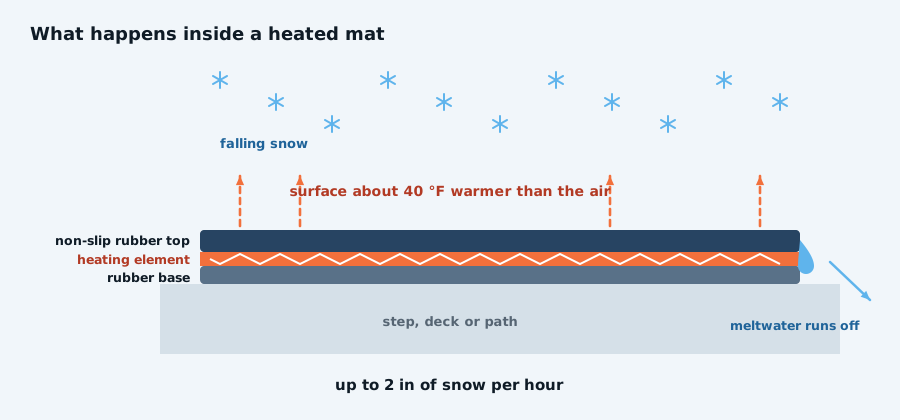
A heated snow melting mat is a heating element sealed inside rubber. HeatTrak describes its mats as a corrosion-resistant polymer blend, with the elements sandwiched between two non-slip rubber surfaces, and its walkway and stair mats come out about 0.5 in thick.
There is no fan or fluid inside. Current flows through the element, the element warms up, and that warmth climbs through the top layer into whatever lies on it, from fresh powder to a thin glaze of ice.
The listings call the mats “designed to be left out all season long.” That matters, because a mat helps most when it is already warm as the snow lands, not after you have trodden a crust into it.
Every watt becomes heat
Any resistive heater turns all of the electrical power it draws into heat. A mat that pulls 300 W puts 300 W of warmth into the snow above it and the ground below, and none of that power leaves as motion or light.
So wattage is the number to watch. More watts spread over the same patch of ground means more heat per square foot, and that decides how quickly a mat can keep pace with falling snow.
HeatTrak lists its mats by amps rather than watts. Multiply by the 120 V a household outlet supplies and you get watts, so the 2.5 A walkway mat works out to about 300 W by our arithmetic (120 V × 2.5 A).
Heat per square foot, mat by mat
Divide each mat’s watts by its area and the five land surprisingly close together. The table uses the listed sizes and our own rounded arithmetic, so read the last column as a comparison rather than a spec.
| Mat | Size | Power | Area | Watts per sq ft |
|---|---|---|---|---|
| HeatTrak walkway (HR20-60) | 20 × 60 in | 2.5 A, about 300 W | about 8.3 sq ft | about 36 |
| HeatTrak stair (HR10-30) | 10 × 30 in | 0.7 A, about 84 W | about 2.1 sq ft | about 40 |
| HeatTrak entrance mat | 24 × 36 in | 1.9 A, about 228 W | 6 sq ft | about 38 |
| Toriexon 20 × 60 | 20 × 60 in | 330 W, about 2.75 A | about 8.3 sq ft | about 40 |
The Toriexon pushes slightly more heat into the same footprint than the HeatTrak walkway mat, roughly a tenth more. Nobody can say from the listings whether that shows on your steps, and the Toriexon still has few owner reviews so far.
The bigger lesson is that no mat here runs far hotter than its rivals. If you want faster clearing, switching on earlier helps more than hunting for a stronger mat of the same size.
What “up to 2 in an hour” means
All four HeatTrak listings and the Toriexon listing promise to melt up to 2 in of snow per hour. Read the “up to” with care, since it describes good conditions, with the mat already warm and the snow soft enough to soak up the heat.
Snow that falls faster than that piles up faster than the mat can melt it. Wind strips heat off the surface as well, and a colder night leaves less warmth over for the snow itself.
The heaviest stretch of a big storm is where a mat can lose the race. Our guide on when a mat falls behind walks through those conditions and what you can do about them.
The 40 °F lift and the cold limit
HeatTrak says the surface runs about 40 °F above the air temperature, in both its listings and its FAQ. On a 20 °F morning that puts the top of the mat near 60 °F by its numbers, comfortably above freezing.
The lift is relative, so it buys less as the air gets colder. At -8 °F, the lowest temperature the walkway listings name, the same 40 °F lift leaves the surface around 32 °F, right at the melting point.
Below that, the arithmetic no longer keeps the surface above freezing. HeatTrak makes no claim for colder air, and the Toriexon listing names no cold limit at all.
Switch it on before the snow starts
A cold mat under fresh snow has to warm its own rubber first, then the snow pressed against it. Turn it on before the first flakes and the surface is already warm, so snow melts on contact instead of building up.
None of the five mats lists a thermostat, so each one heats whenever it has power. HeatTrak’s FAQ says leaving its mats on all winter does not wear them out, which hands the decision to your power bill rather than to the mat.
What that habit costs depends on watts and hours. Our running cost guide does the kWh math for every mat in this group, and it is short enough to repeat with your own bill in hand.
Where a mat beats salt, and where it doesn’t
Rock salt stops working well once the air drops below about 15 °F, and it damages concrete and plants as it washes off. A heated mat needs no salt and keeps melting in cold that has already beaten the salt.
A mat only covers its own footprint, though. Salt spreads across a whole driveway while a mat clears one strip, so our comparison of mats, salt and heat cable helps when the area you need clear is large.
Matching the heat to your path
Since a mat clears only what it covers, the size and number you choose matter more than any small gap in wattage. Our mat size guide shows how to measure a path and a flight of steps before you order.
To see the five side by side, open the comparison table or the short section on how heated mats work on the homepage. The full list of the best snow melting mats we recommend sits there too, with each one’s catch spelled out.
For a front walk that ices over
The HeatTrak walkway mat puts about 300 W into a 20 × 60 in strip and melts up to 2 in of snow an hour, by HeatTrak’s figures. On its own it does nothing, so budget for the separate Power Unit or pick the version that ships with one.
