How to fit heated stair mats to outdoor steps
Steps are where a slip on ice hurts most, and a long walkway mat doesn’t fit them. Heated treads lie one per step and chain to a single Power Unit, so the fit and the cord plan matter more than anything on the box.
Why steps need their own mats
A stair is a row of narrow, separate surfaces, and a 20 × 60 in walkway mat suits none of them. Heated stair treads are cut for that shape, with one mat lying on each step and a short cord leading on to the next.
In our lineup that job goes to the HeatTrak stair mat, a 10 × 30 in tread drawing 0.7 A at 120 V. By our own arithmetic that comes to about 84 W per tread, a small load next to a walkway mat.
HeatTrak rates it like its walkway mats, with a melt rate of up to 2 in of snow an hour and a surface held roughly 40 °F over the air temperature. Owners say the treads keep steps clear and feel safe on concrete, though some find them warm quickly and others not warm enough.
The three tread sizes
HeatTrak sells its stair mat in three lengths, and every one of them is 10 in deep. That fixed depth means the choice comes down to the width of your steps and how much of each one should stay clear.
| Tread | Clear strip across the step | Power draw in our sources |
|---|---|---|
| 10 × 30 in (HR10-30) | 30 in | 0.7 A, about 84 W |
| 10 × 48 in | 48 in | Not stated, read the label |
| 10 × 60 in | 60 in | Not stated, read the label |
The 10 × 30 in tread is pick 2 on our home page and sits in the $ band. For the two longer treads, take the amperage from the listing or the mat’s label before you plan a chain, since our sources give no figure for them.
Measuring your steps
Measure every step twice, front to back and side to side, and write both numbers down. The front-to-back figure is the tread depth, and it should be at least 10 in so a HeatTrak tread lies flat without hanging off the edge.
The side-to-side figure picks the length. Choose the longest tread that still leaves some bare step at each end, so the cord can leave the mat cleanly and the mat doesn’t ride up against a post or wall.
- Count every step that catches snow, plus an open landing at the top
- Measure the depth of each step, since steps are not always identical
- Measure the width you want clear, not the full step between the sides
- Mark where the nearest outdoor GFCI outlet sits, top or bottom
- Measure from that outlet to the first mat for the cord plan
A wide landing or a path at the top often suits a walkway mat better than another tread. Our guide on how many mats you need covers that mix, and stair treads or a walkway mat puts the two formats side by side.
Chaining treads to one Power Unit
HeatTrak treads never plug into the wall directly. Each set of HeatTrak walkway and stair mats runs from one HeatTrak Power Unit, an outdoor-rated box with a GFCI and a 6 ft cord, and the treads link to it and to each other.
HeatTrak’s FAQ caps one Power Unit at 13 A of mats, while the stair listing says up to 14 A. Plan to the lower number and you keep a margin whichever source turns out to be stricter.
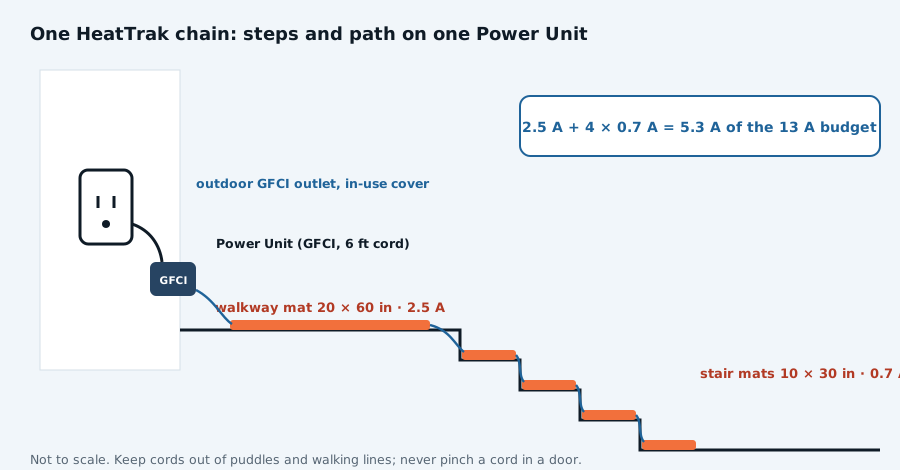
The chain in the figure is a typical porch, one 20 × 60 in walkway mat plus four 10 × 30 in treads. Add 2.5 A and four times 0.7 A and you reach 5.3 A, well under half of that 13 A ceiling.
The HR20-60 manual works a bigger case, three walkway mats and five treads for 11 A in all. Beyond the cap you need a second Power Unit on a second outlet, and the guide to amps and breakers shows how to check what else shares the circuit.
Without a unit yet, start the chain with the HeatTrak walkway mat that comes with its Power Unit. Treads bought on their own stay cold until a unit is connected, and a missing unit is the most common complaint among owners of the plain walkway mat.
Routing the cord down a stair
A loose cord can turn a cleared stair into a trip hazard. Run each tread-to-tread link down the side of the stair, along the wall or the outer edge, and never across the middle of a step where feet land.
Keep every connection out of standing water, and don’t let a joint sit in a low corner where meltwater gathers. For an outlet more than 6 ft from the first mat, HeatTrak offers chainable watertight extenders, 10 ft or 25 ft long.
You may also use a plain extension cord, as long as it is 14 gauge or heavier, made for outdoor use and joined somewhere dry. Never pinch a cord in a door or gate, and never cut a mat to make it shorter.
GFCI protection and an in-use cover on the outlet are not optional, and the National Electrical Code expects both outdoors anyway. Our guide to cords, GFCI and mat safety goes through the full setup, and an electrician can settle any doubt about the circuit.
Keeping treads from sliding
HeatTrak’s FAQ describes non-slip rubber on both faces of the mat, so a tread grips a clean, dry step on its own. Trouble starts when the tread goes down on top of ice or packed snow, so lay it before the first storm.
The stair listing in our sources mentions no screws, clips or grommets. Only the HeatTrak entrance mat lists fixing points, four 3/8 in grommets, so ask HeatTrak what it approves before you improvise anything on a tread.
- Center each tread on a clean, dry step before snow is forecast
- Keep the front edge on the step rather than hanging over the nose
- Never drill, nail or screw through a mat, as that damages the heating element
- Check after each thaw that every tread still sits square
- Let the heat clear the snow, never a shovel, ice chipper or snow blower
HeatTrak’s 2-year warranty excludes incorrect installation and abuse. A hole punched through a tread to hold it down risks both the mat and that cover.
Through the winter and after
Treads can stay out for the whole winter, as the listings say the mats are designed to. HeatTrak’s FAQ adds that leaving them switched on does not wear them out, so turn them on before the snow starts and let them run.
In spring, let them cool, look over each cord and plug, and store them flat. The care and storage guide covers capping the connectors and what the warranty includes.
Still weighing treads against other mats? Our roundup of the best heated mats for stairs and paths has all five, and the comparison table lines up their sizes and power draw.
If your steps take the snow
The HeatTrak stair mat is the tidiest way to keep a stair clear, one 0.7 A tread per step on a shared Power Unit. Budget for the unit if you don’t own one yet, and plan the cord route before the first storm.