What a heated snow mat costs to run
Electricity is the cost that keeps arriving after the mat is paid for. The math takes one line, and once you know your mats’ watts and the rate on your own bill, you can price a storm in about a minute.
The one-line formula
Your utility bills you for kilowatt-hours, and a mat’s use in kWh comes from two numbers. Multiply its watts by the hours it runs, then divide by 1,000.
Watts × hours ÷ 1,000 = kWh. Multiply the result by the rate per kWh printed on your power bill and you have the cost. Rates differ between utilities and through the year, so we never print one here.
If a listing gives amps instead of watts, multiply by 120 first. HeatTrak rates its walkway mat at 2.5 A, which works out to about 300 W by our arithmetic.
One hour on each mat
Each line runs the formula for a single hour of heat. The HeatTrak wattages come from their listed amps at 120 V, our arithmetic, while the Toriexon’s 330 W comes straight from its listing.
- HeatTrak walkway mat, about 300 W: 300 × 1 ÷ 1,000 = 0.3 kWh
- HeatTrak stair mat, about 84 W: 84 × 1 ÷ 1,000 = 0.084 kWh
- HeatTrak entrance mat, about 228 W: 228 × 1 ÷ 1,000 = 0.228 kWh
- Toriexon 20 × 60 in, 330 W: 330 × 1 ÷ 1,000 = 0.33 kWh
The HeatTrak walkway mat with Power Unit is the same 300 W mat, so it shares the first line. A unit only adds cost through the mats you chain to it.
Longer runs, 6 to 24 hours
Use scales in a straight line with time. A 300 W walkway mat left on for 10 hours uses 3 kWh, and a full day uses 7.2 kWh, as the table and chart below show for each mat.
| Mat | Watts | 6 hours | 12 hours | 24 hours |
|---|---|---|---|---|
| HeatTrak walkway 20 × 60 in | about 300 W | 1.8 kWh | 3.6 kWh | 7.2 kWh |
| HeatTrak stair 10 × 30 in | about 84 W | about 0.5 kWh | about 1.0 kWh | about 2.0 kWh |
| HeatTrak entrance 24 × 36 in | about 228 W | about 1.4 kWh | about 2.7 kWh | about 5.5 kWh |
| Toriexon 20 × 60 in | 330 W | about 2.0 kWh | about 4.0 kWh | about 7.9 kWh |
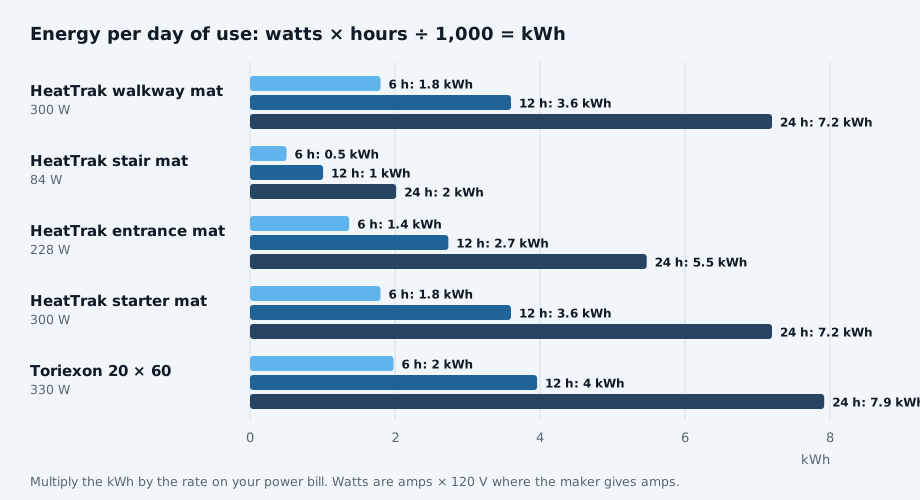
Figures are rounded and assume the mat draws its full rating the whole time. With no thermostat on any of the five, that is a fair assumption for as long as each one stays plugged in.
Pricing a whole chain
A chain is the sum of its mats. One walkway mat plus four stair treads draws 5.3 A, about 636 W, so it uses roughly 0.64 kWh for every hour it runs.
HeatTrak’s manual example of three walkway mats and five treads draws 11 A. That is about 1,320 W, or 1.32 kWh an hour, and close to 15.8 kWh if it runs for 12 hours through a long storm.
For your own set, add the watts or amps of every mat, then run the formula once. Our guide to amps and outlets shows how to total a chain and check it against the circuit too.
HeatTrak’s own estimate
HeatTrak’s FAQ puts the cost at about 18 cents an hour, by HeatTrak’s own estimate, for a typical set of mats. That figure is the maker’s claim, built on a rate and a set size that may not match yours.
Treat it as a ballpark and redo the sum with your numbers. Take your set’s kWh per hour from the table above, multiply by the rate on your bill, and the result fits your home rather than an average.
We never quote an electricity price, because rates vary by utility and change over time. The rate per kWh on your own bill, times the kWh above, is the only cost figure you can rely on.
Hours are the lever you control
No thermostat appears on any of the five, so each draws its full watts for as long as it has power. A winter’s cost depends far more on the hours you leave them on than on the small wattage gaps between models.
Switching on before the snow starts gives the mat time to warm, which is how it stays ahead of the snowfall. Our explainer on how heated mats melt snow covers that warm-up side in detail.
According to HeatTrak’s FAQ, a whole winter switched on causes no extra wear. That makes it purely a cost choice, so weigh the extra kWh against the comfort of never touching the switch.
Heavy storms push the hours up, since a mat struggling to keep pace has to stay on longer. Our guide on when a mat falls behind covers the conditions where that happens.
Running cost against buying cost
The mat’s price comes once, while electricity comes every storm. A cheaper mat with similar watts costs about the same to run as a dearer one, so compare watts and hours rather than assuming the budget model saves power.
The Toriexon 20 × 60 in mat shows the trade. At 330 W it uses roughly a tenth more energy per hour than HeatTrak’s 300 W walkway mat of the same size, in exchange for skipping the separate Power Unit.
If the purchase price matters most, our look at a good mat under $150 weighs the low end. To set electricity against other ways of clearing ice, see our comparison of mats, salt and heat cable.
For watts and sizes side by side, open the homepage comparison table, or the Toriexon card for the option without a power unit. Our choice of the best heated snow melting mat for most homes sits at the top of that page.
For the lowest draw per step
A HeatTrak stair tread draws about 84 W by our arithmetic, so even five of them use only about 0.42 kWh an hour. They need a Power Unit, which you buy once for the whole chain.
