Heated stair treads or a walkway mat, which HeatTrak mat goes where
HeatTrak makes a narrow tread for each step and a long mat for flat ground. They draw very different amps, yet both plug into one Power Unit, so many homes end up with some of each.
Treads for the steps, a long mat for the path
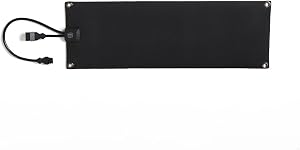
The HeatTrak stair mat and the HeatTrak walkway mat cover different parts of the route to your door. The stair mat is a 10 × 30 in tread for one step, while the walkway mat is a 20 × 60 in runner for a level path, a porch or a landing.
Pick the HeatTrak stair mat when the slippery part is a flight of steps, one tread per step. Pick the HeatTrak walkway mat for level ground or the landing at the top, where a narrow tread would leave most of the surface cold.
Both sit among our heated snow mat picks, as pick 2 and pick 1. For a front door with no steps, see door mat or walkway mat, and treads face a single plug-in mat in stair treads or one Toriexon.
Stair mat and walkway mat side by side
All figures come from HeatTrak’s two listings and its residential FAQ. Watts and square feet are our arithmetic from the listed amps and sizes.
| Feature | HeatTrak stair mat (HR10-30) | HeatTrak walkway mat (HR20-60) |
|---|---|---|
| Size | 10 × 30 in, about 0.5 in thick | 20 × 60 in, about 0.5 in thick |
| Coverage | 300 sq in, about 2.1 sq ft per tread | 1,200 sq in, about 8.3 sq ft |
| Power draw | 0.7 A at 120 V, about 84 W | 2.5 A at 120 V, about 300 W |
| Power unit needed | Yes, HeatTrak Power Unit sold separately | Yes, sold separately (or as the HR20-60P with one) |
| GFCI | In the Power Unit | In the Power Unit |
| Chaining | To a walkway mat or straight to the unit | To treads and other walkway mats |
| Melt rate | Clears up to 2 in of snow an hour (HeatTrak) | Identical claim |
| Cold rating | Surface roughly 40 °F warmer than the air | Same rise, rated to -8 °F (listing) |
| Fixing | None named on the listing | None named either |
| Other sizes | 10 × 48 and 10 × 60 in | 20 × 30, 30 × 30 and 30 × 60 in |
| Owner feedback | Keeps steps clear, easy setup; heat opinions mixed | The most-reviewed on Amazon; top complaint is the unit not included |
| Warranty | 2 years, counted from shipment | 2 years, same terms |
| Price band | $ per tread | $$ |
Fit on the steps
A 10 by 30 in tread is shaped for one step. Laid on a stair, it covers the part your boot lands on, and a short flight of four steps takes four treads, each 2.89 lb and about 0.5 in thick.
A walkway mat 20 in wide and 60 in long cannot sit flat on a single step, and a mat must never be cut to fit. If your steps run wider than 30 in, the stair listing also offers 10 × 48 and 10 × 60 in treads.
Our guide to heated mats for steps goes through measuring each tread and keeping the connector cords off the walking line.
Round goes to the stair mat for steps.
Coverage on a path or a landing
On flat ground, one 20 × 60 in walkway mat covers about 8.3 sq ft, four treads’ worth of surface on a single connector. A landing or a stretch of sidewalk needs that width, since a 10 in strip leaves both edges under snow.
Longer paths take several walkway mats chained end to end. Our mat size guide shows how to count mats for a path and a porch before you order.
Round goes to the walkway mat for paths and landings.
Amps, watts and one Power Unit
Each tread draws 0.7 A, about 84 W by our arithmetic, while the walkway mat draws 2.5 A, about 300 W. Both chain to one HeatTrak Power Unit, which holds the GFCI and should carry no more than 13 A per HeatTrak’s FAQ (some listings say 14).
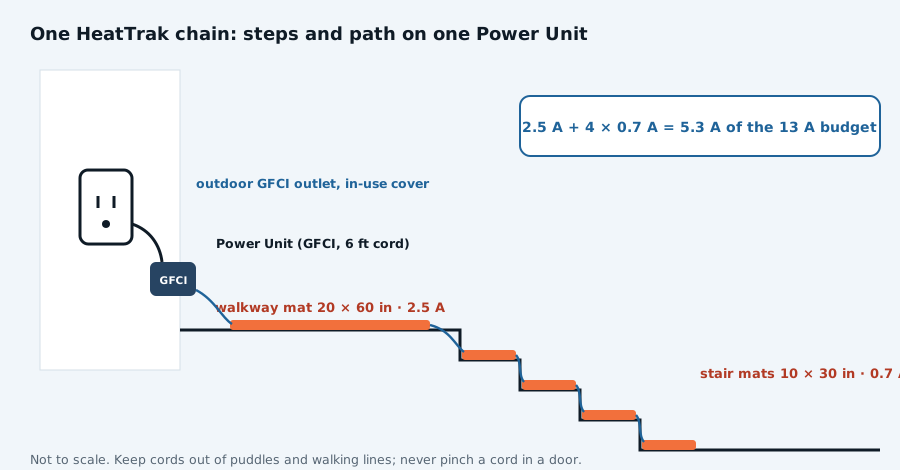
A common layout is one walkway mat on the landing plus four treads down the steps. That comes to 2.5 A plus 2.8 A, or 5.3 A, well inside the budget, and the manual’s own example of three walkway mats with five treads reaches 11 A.
The circuit matters as much as the unit. Keep a continuous load at or below about 12 A on a 15 A circuit, count anything else on that breaker, and ask an electrician if you are unsure. Our amps and outlets guide works through the numbers.
A draw, the two share one unit with plenty of headroom.
Melting and cold
HeatTrak claims one melt rate for both, as much as 2 in of snow an hour, plus a matching surface rise of about 40 °F over the air. Only the walkway listings add a low limit, saying the mat works well down to -8 °F.
Walkway mat owners report that it heats up quickly. Stair mat owners are split, some saying the surface turns warm inside 15 minutes and others saying it never gets warm enough, so switch treads on before the snow starts rather than after it piles up.
Round goes to the walkway mat, for steadier owner reports on heat.
Price for the whole route
A single tread sits in the $ band, under $150, and the walkway mat in the $$ band. A staircase multiplies the tread’s cost by the number of steps, so price the full flight before you compare it with one mat.
Either way, a first-time buyer also needs a Power Unit, sold separately. By HeatTrak’s own reckoning, running a typical set comes to about 18 cents an hour, and a tread’s 84 W uses far less than a walkway mat’s 300 W.
Both carry HeatTrak’s 2-year warranty from shipment and are designed to be left out all season. Keep shovels, metal tools and snow blowers off either one.
A draw on value, it depends on your route.
Most homes with steps need both. Buy only one type and a path that ends in stairs leaves you with either cold treads or a cold landing, while a tread laid on flat ground covers too little to help.
Because the two chain together on one Power Unit, you can start with treads now and add a walkway mat next winter. Place the unit where both can reach it without a cord crossing the steps.
Steps first, then the path
For a flight of outdoor steps, order one HeatTrak stair mat per step plus a Power Unit. For a level path or a landing, the HeatTrak walkway mat covers four times the area of a tread on one connector.