What a cheap snow melting mat gets you, and what it leaves out
Only one mat in our lineup sits under $150 on Amazon.com, and it can’t heat anything on its own. This page shows what the low end buys, where the money goes on a first setup and which warning signs to look for on cheaper no-name mats.
How we sort mats by price
We never print a price, because Amazon prices move from week to week. Every mat goes into a band instead, with $ for under $150 and $$ for $150 to $250.
Anything above $250 counts as $$$. The bands come from Amazon.com listings read with delivery to a New York address, so check the live listing before you order.
Of the five mats in our snow melting mat comparison, one lands in the $ band, three sit in $$ and one crosses into $$$. That spread says less about quality than about what comes in the box.
The one mat under $150 is a stair tread
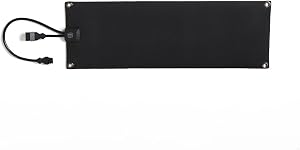
The lowest-priced mat of the five is the HeatTrak stair mat, a 10 × 30 in tread made for a single step. At 120 V it pulls 0.7 A, roughly 84 W by our arithmetic, and HeatTrak rates it to clear as much as 2 in of snow an hour.
Owners in Amazon’s review summary say it keeps steps clear and feels safe underfoot on concrete. Opinions on heat are split, with some reporting a warm surface within 15 minutes and others finding it not warm enough.
It sits on our homepage as pick 2, the mat for steps. Our HeatTrak stair mat review covers its sizes, layout and 2-year warranty in full.
The part that isn’t in the box
A HeatTrak stair mat does nothing until it is plugged into a HeatTrak Power Unit, which is sold separately. That unit carries the GFCI along with a 6 ft cord, and a single one feeds a whole chain of treads and walkway mats.
So a single tread is not a complete setup under $150. If you already own a Power Unit, adding a tread is the cheapest way to grow your chain, and if you don’t, plan the unit into your budget from the start.
Five mats, band by band
The table lists each mat with its size, its power draw and the band its Amazon price falls into. Watts marked as our arithmetic come from amps times 120 V.
| Mat | Size | Power draw | Power Unit | Price band |
|---|---|---|---|---|
| HeatTrak stair mat | 10 × 30 in | 0.7 A (roughly 84 W, our arithmetic) | Needed, sold separately | $, lowest of the five |
| HeatTrak walkway mat | 20 × 60 in | 2.5 A (roughly 300 W, our arithmetic) | Needed, sold separately | $$ |
| HeatTrak entrance mat | 24 × 36 in | 1.9 A (roughly 228 W, our arithmetic) | Own GFCI unit included | $$ |
| Toriexon 20 × 60 | 20 × 60 in | 330 W (roughly 2.75 A, our arithmetic) | None, plugs into a GFCI outlet | $$ |
| HeatTrak mat with Power Unit | 20 × 60 in | 2.5 A | Included | $$$ (just over $250) |
Prices shift between sellers and weeks, so a mat can cross a band line. The comparison table on our homepage sets all five side by side on size, power and melt rate.
What a first setup costs in practice
The sticker on one mat is rarely the whole bill. What you pay depends on two things, whether you need a Power Unit and how many mats your path and steps take.
Starting from nothing with HeatTrak
A first-time HeatTrak buyer needs a mat plus a Power Unit. The walkway mat with the unit included, sold as the HR20-60P, sits just over the $250 line, while the plain walkway mat sits in the $$ band without one.
Every stair tread or walkway mat you add after that plugs into the same unit. That makes the second and third mats cheaper per step than the first.
Plug-in mats with no separate unit
Two mats skip the Power Unit altogether. The HeatTrak entrance mat comes with its own GFCI power unit and cord, and the Toriexon 20 × 60 mat takes its power directly from an outdoor GFCI outlet.
Both sit in the $$ band, so neither is a budget mat, but either gives you a working mat from a single purchase. The entrance mat cannot connect to other mats, while Toriexon says its mats can be linked up to 1,500 W in total.
Cords and extenders
The Power Unit cord is 6 ft long, so a mat farther from the outlet needs more reach. HeatTrak sells watertight 10 ft and 25 ft extenders that chain together, and the 10 ft version sits in the $ band.
Per HeatTrak’s FAQ you can also use an outdoor-rated extension cord, so long as it is 14-gauge or heavier and its connection sits clear of water. Our guide to how many mats you need helps you count mats and cord length before you buy.
Unbranded mats and the red flags they carry
Search Amazon.com for a heated mat and you will find unbranded sets priced below anything in our five. We looked at several and left them out, for reasons you can check on any listing yourself.
Six-packs of treads and long runners
Packs of six 10 × 30 in treads and long runners around 13 in × 10 ft show up often. On the ones we looked at, owners report breakers tripping and mats that stopped working within weeks.
Some owners also call the surface slippery, which defeats the point of a mat on a step. Six treads on one outlet add up fast, so do the sums in our guide to amps and outlets before you plug a set in.
Claims that can’t be true
One graphene mat we came across claims 106% energy conversion. No heater turns more than 100% of its electrical power into heat, so a claim like that tells you how carefully the rest of the listing was written.
The same mat promises 3 in of snow per hour without stating its wattage. Without watts you can’t check the melt claim or the load on your circuit, and both matter more than any headline number.
A voltage range that doesn’t fit
One unbranded listing says its mat runs on 110 V to 240 V. A mat built for US household outlets runs on 120 V, and a wide range on a simple heating mat suggests a listing copied from elsewhere rather than written for the product.
What to check on any budget mat
Run through these checks on the listing before you order, whatever the brand or band. A listing that can’t answer most of them is telling you something.
- A stated wattage or amp draw, so you can add up the load on your circuit
- 120 V on the label, matching a standard US outlet
- A GFCI, either built into the mat’s power unit or provided by your outdoor outlet
- A named certification for the cord and plug, such as UL or ETL
- A warranty term in writing, like the 2 years HeatTrak gives from the date of shipment
- A non-slip surface that owners don’t complain about
- Free returns, which all five of our mats showed on Amazon.com
Spending less without cutting corners on safety
The cheapest way to clear a path is to heat only the spots where people slip. A tread on each step plus one walkway mat at the landing can do more for you than a long runner on a flat path.
If you already own a HeatTrak Power Unit, each extra tread costs less than any standalone mat. HeatTrak’s FAQ says leaving mats on all winter doesn’t wear them out, so you can switch them on before the snow starts.
A low price never changes the wiring rules. Each mat still plugs into an outdoor outlet that has both GFCI protection and an in-use cover, and HeatTrak walkway and stair mats need the HeatTrak Power Unit.
Keep each Power Unit within 13 A per HeatTrak’s FAQ (some listings say 14) and use only outdoor-rated 14-gauge or heavier cords. Never cut a mat or clear it with a shovel, and if you’re unsure what else runs on that circuit, ask an electrician.
Our pick if you want to spend the least
If you already own a HeatTrak Power Unit, or plan to build a chain over a few winters, the HeatTrak stair mat is the only one of our five under $150. Start with the steps where people slip and add mats as your budget allows.